
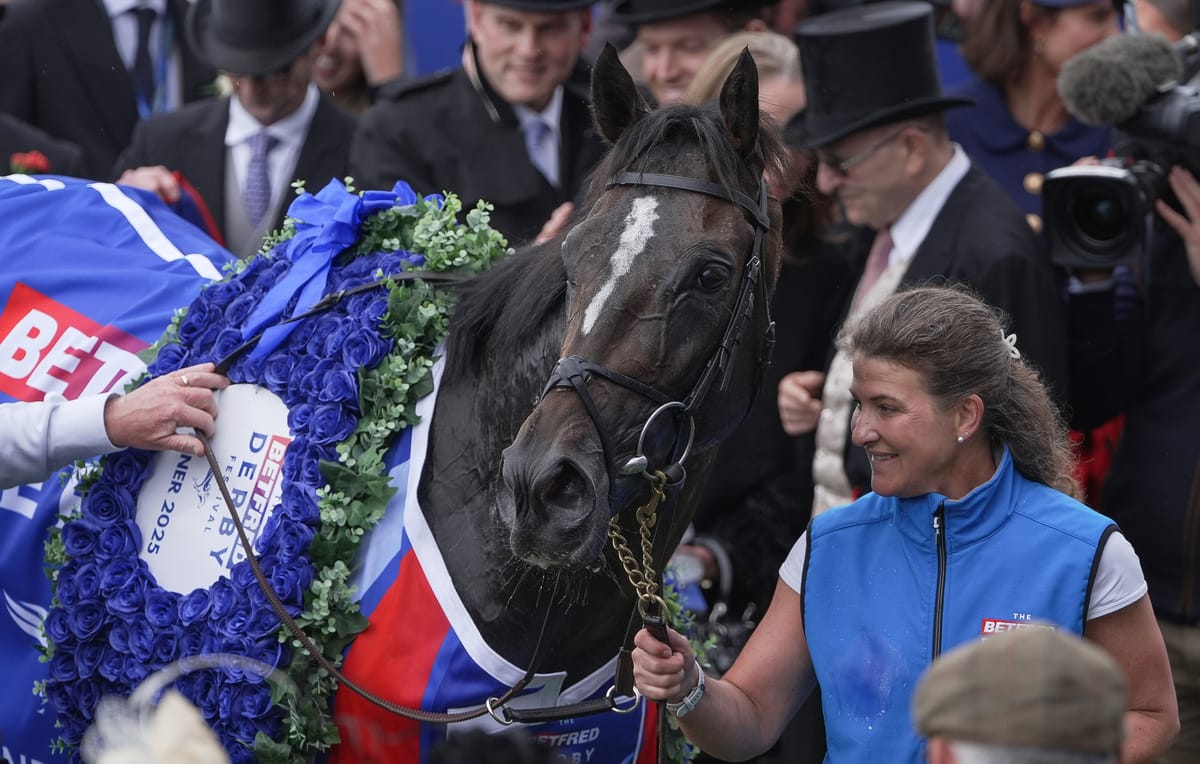
...and Australia's record puts him amongst the best current middle-distance sires in Europe
International Thoroughbred Xtra with the Weatherbys Stallion Scene by Jocelyn de Moubray
Week 4
FOR A HORSE to be competitive in an Epsom Classic he or she has to stay 1m4f – and most horses who can stay that trip at the beginning of June, at such an early point in their three-year-old season, are by middle-distance sires.
As a rule of thumb, the average winning distance of the progeny of a middle-distance sire is 1m1f or further
There are exceptions, of course, and the latest (as discussed in Week 3's newsletter) appears to be Wootton Bassett, whose average winning distance is only 8.3f and whose progeny includes numerous Group 1-winning two-year-olds, as well as Whirl and Tennessee Stud, second and third in this year's Oaks and the Derby.
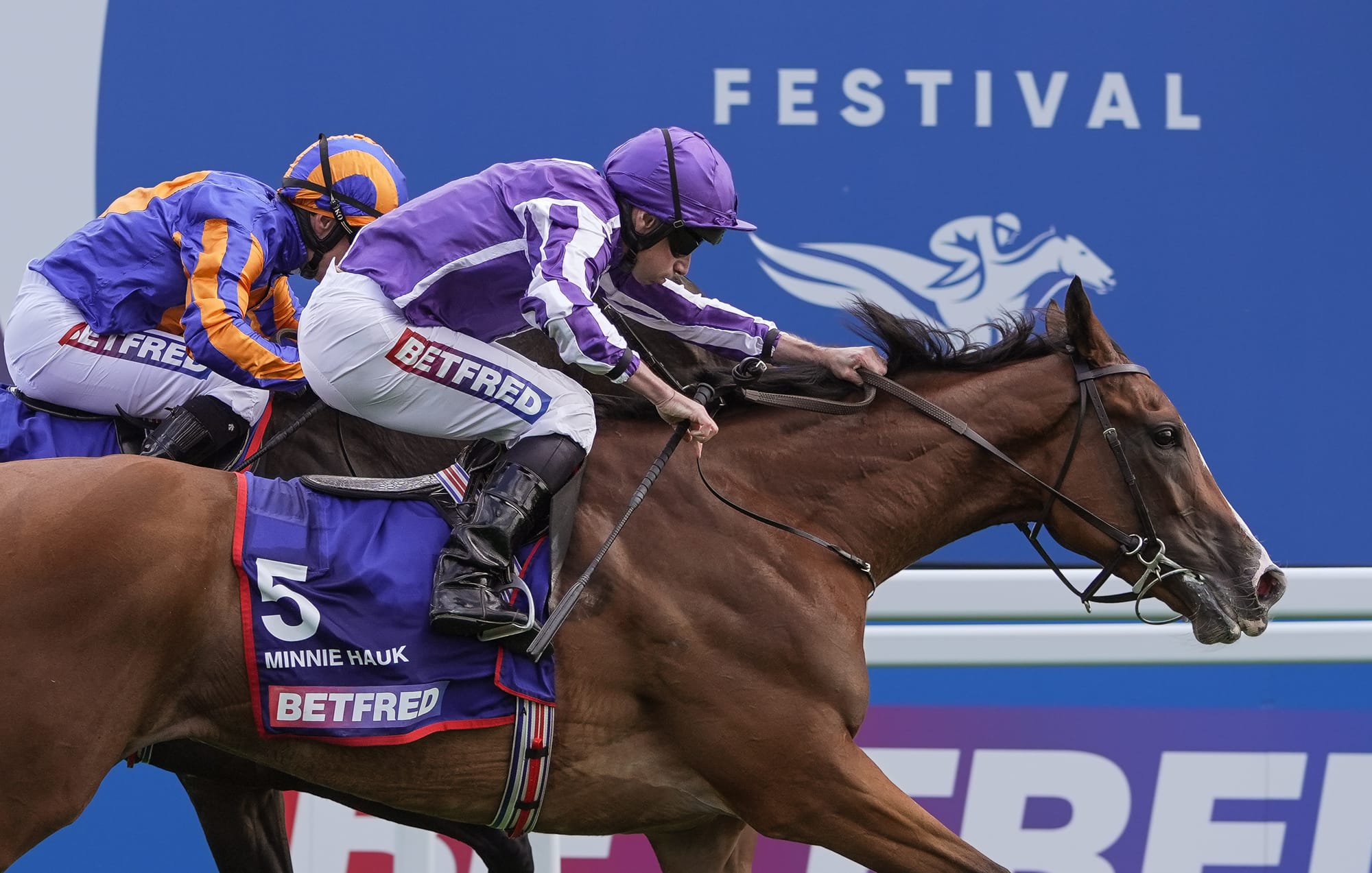
The Oaks winner Minnie Hauk is the tenth "major" European Classic winner from the first eight crops of Juddmonte’s Frankel [11th in total including Logician's St Leger victory, see Week 3's newsletter for JdeM's definition of a "major" Classic].

It is the second Classic winner this year for the stallion after Lake Victoria’s win in the Irish 1,000 Guineas, and the champion sire's progeny’s average winning distance is 9.5f.
Third behind Minnie Hauk and Whirl was Night Of Thunder’s daughter Desert Flower, who lost her unbeaten record, and who is unlikely to be seen over such a long trip in the future, her sire’s average winning distance being less than a mile.
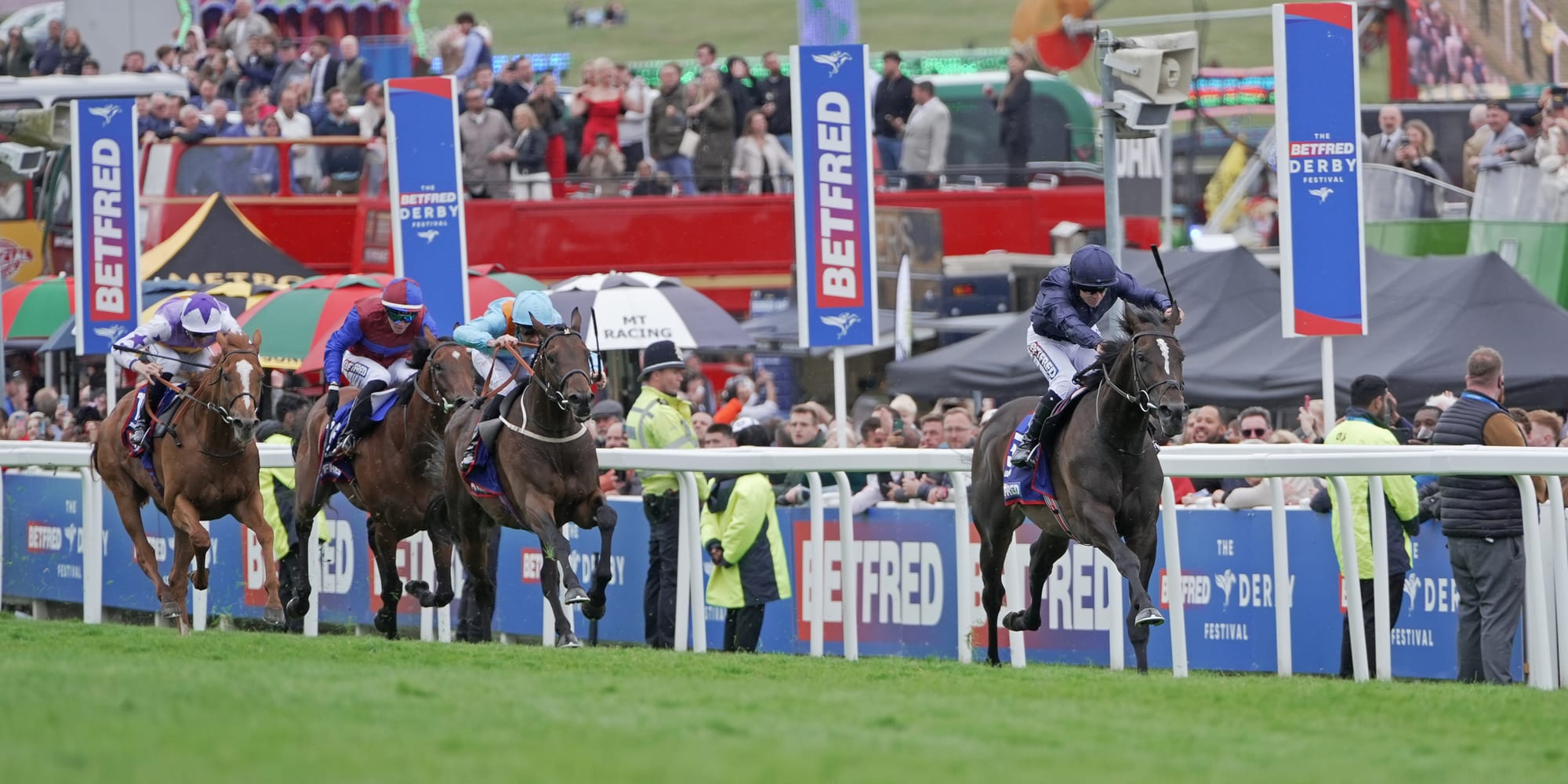
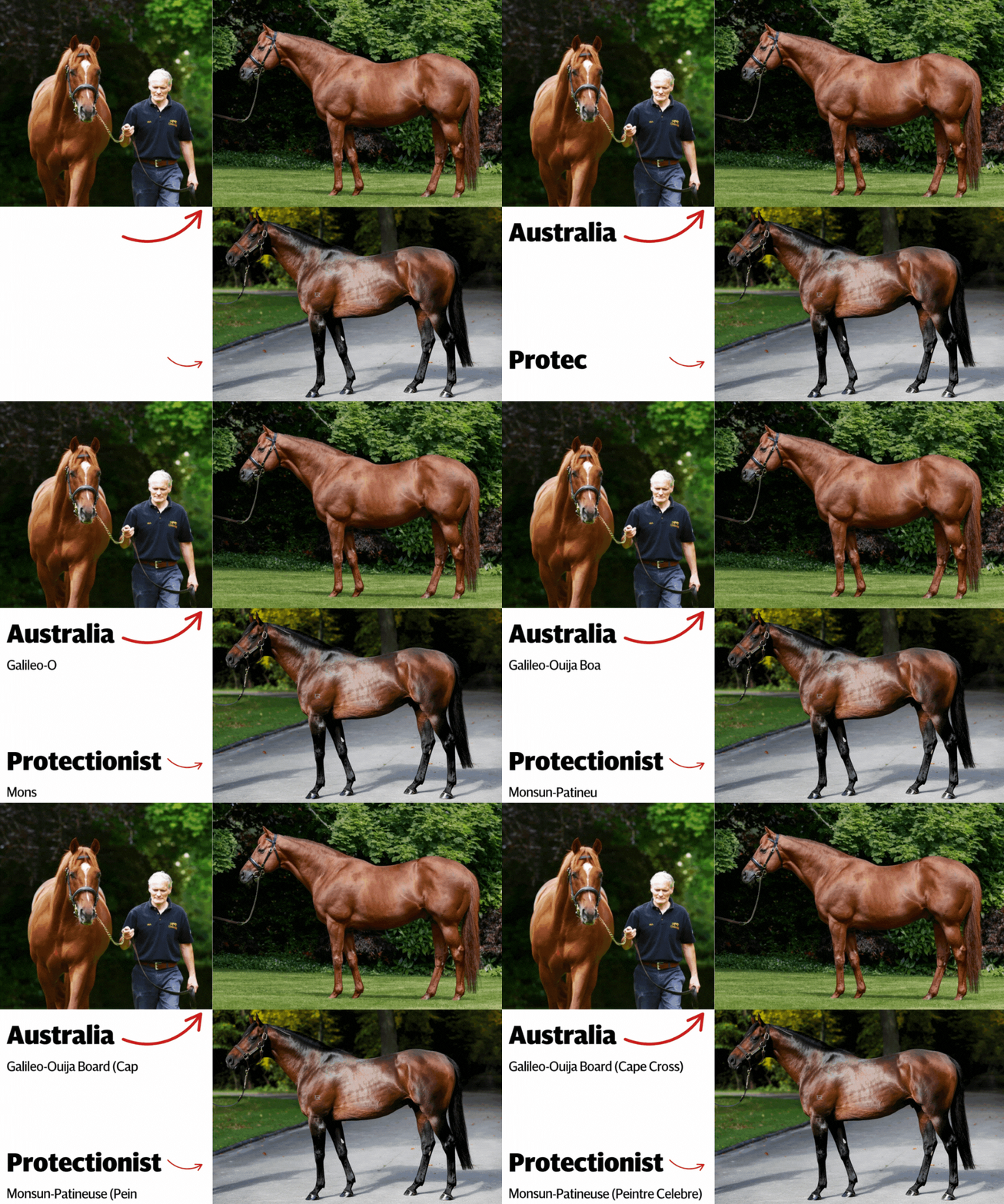
The Derby winner Lambourn is the first major Classic winner from the seven crops of three-year-olds produced by Coolmore’s Australia (and the stallion's second in total, his second-crop son Galileo Chrome won the St Leger in 2020), and the average winning distance for his progeny is 10.3f.

The runner-up Lazy Griff is from the fifth crop of the Melbourne Cup winner Protectionist, who stood for seven years at Gestüt Rottgen.
There was a time when many owners and breeders were looking to produce or buy horses likely to be middle-distance three-year-olds, but this is no longer the case in Britain and Ireland.
In Germany it may still be so, but even there some successful Classic sires are now struggling to maintain support, the problem being, as much as anything else, the dwindling number of breeders and mares based in the country.
Australia, a dual Derby winner, started out his stud career at Coolmore standing at €50,000 in 2015, but was available at €10,000 this year, while Protectionist had been moved to stand as a jumps sire in France before his death in 2023.
This change away from middle-distance breeding was not inevitable, but is the result of the way owning and breeding racehorses in Europe has changed and how the sport has become a business rather than a leisure activity or an indulgence.
In Japan, racing and betting has a very different financial structure, and four of the five leading Japanese-bred and raced sires are either Japanese Derby or St Leger winners. Perhaps the best of them is Kitasan Black, a dual winner of the Group 1 Tenno Sho over two miles and the sire of Equinox and this year's Japanese Derby winner Croix Du Nord.
Croix du Nord (Kitasan Black) winning the Japanese Derby: his sire, a son of Black Tide (Sunday Silence), won the Tenno Sho (G1) over two miles
Australia was an excellent Derby winner in 2014. The son of two outstanding Epsom Classic winners in Galileo and Ouija Board, he was a Group winner at two and finished a close third to Night Of Thunder and Kingman in the 2,000 Guineas before winning the Derby as a short-priced favourite. The Aidan O’Brien-trained colt improved further still to beat the Prix du Jockey-Club (G1) winner The Grey Gatsby to win the 1m2f Juddmonte International (G1).
He retired to stud with high expectations and came close to producing a Derby winner in his first crop when Broome finished fourth, less than a length behind the winner, his stable companion Anthony Van Dyck.
Broome went on to win the Group 1 Grand Prix de Saint-Cloud and Australia’s second crop included three more Group 1 winners – Mare Australis, Galileo Chrome and Order Of Australia.
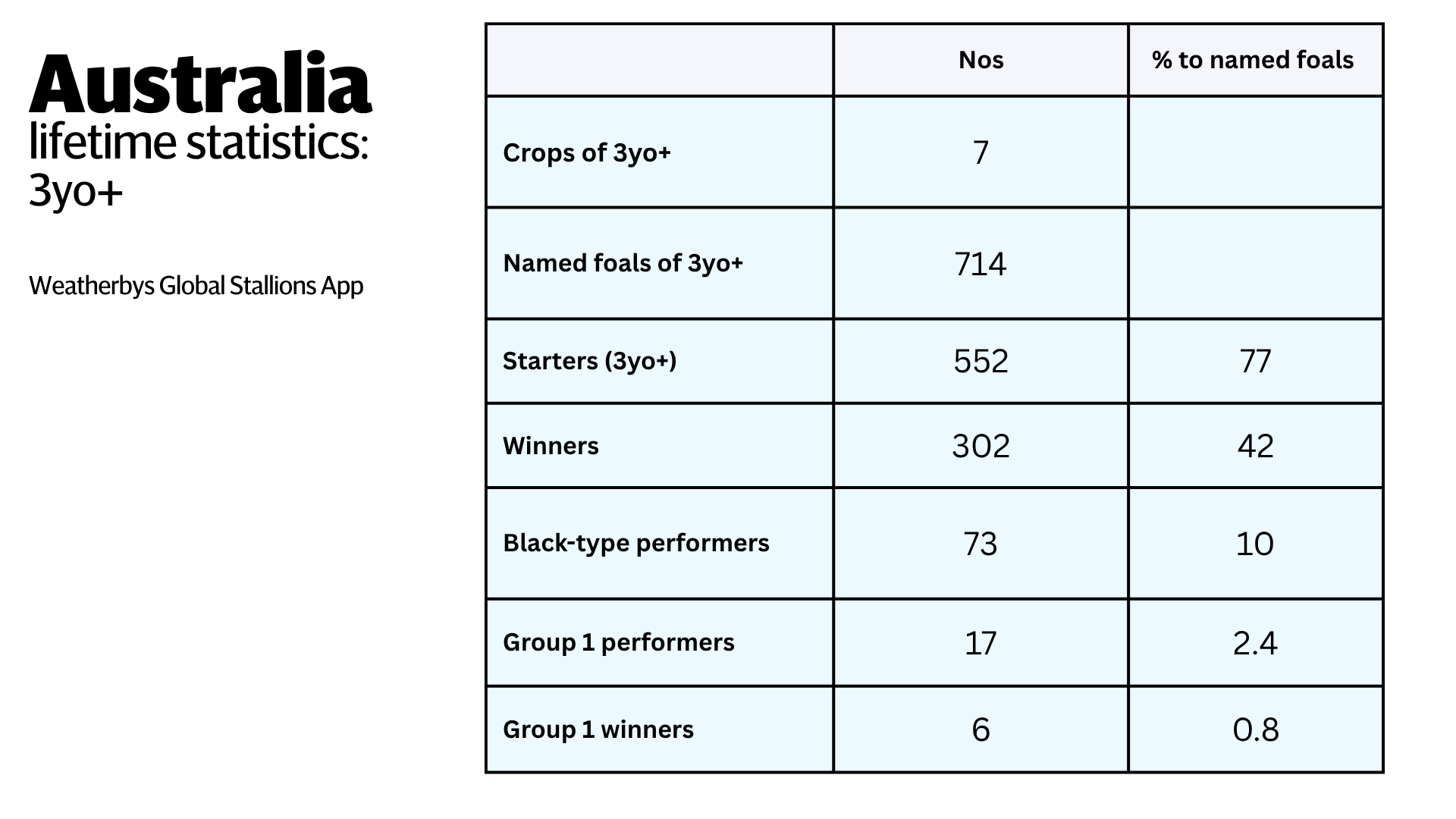
Overall, from his first seven crops, Australia has produced 714 named foals of which 10 per cent are stakes performers, 0.8 per cent Group 1 winners and 2.4 per cent Group 1 performers.
Of course, Australia is not in the same league as his father Galileo, but his record puts Australia amongst the best current middle-distance sires in Europe
However, as 75 per cent of his three-year-old winners have come over 1m2f or further, the opportunities they have are restricted, alongside the demand for them in the yearling market.
Protectionist was another very high-class performer. The son of Monsun was a leading contender for the Deutsches Derby (G1), but an injury kept him off the track for ten months from June as a three-year-old. He returned at four for a campaign aimed at the Group 1 Melbourne Cup, a race he won brilliantly by 4l for trainer Andreas Wohler. He remained in Australia at five, but failed to win only to return to Wohler at six and win a Group 1 over 1m4f in Berlin putting up exceptionally fast fractions.
In his first five years at stud, Protectionist produced only 168 named foals. Lazy Griff is probably the best of them, but they also include the top filly Amazing Grace and the Derby runner-up’s full-brother Lambo, a Group winner at three who was injured at the beginning of his three-year-old year and never returned to his best.
When a stallion has only a handful of horses to run an injury to a good one is a major blow.
Protectionist produced some horses with quality, but too many of these lacked physical toughness to fulfil their potential and, as is often the case with middle-distance horses, many were backward horses who needed time to mature.
And yet Australia’s three-year-olds include the Derby winner Lambourn and the Oaks fourth Wemightakedlongway, and from only 22 named three-year-olds Protectionist has produced Lazy Griff, a Group winner at two and runner-up in the Derby.
He is also becoming a hugely promising damsire with the Group 1 winner Lazzat and this year's Group 1 Lockinge Stakes runner-up Dancing Gemini out of his mares.
He is broodmare sire of four black-type winners this year and is one of the youngest stallions to have registered multiple black-type winners this season.
XTRA WINNER
DARYZ
2022 c
Sea The Stars-Daryakana (Selkirk)
Trainer: Francis Graffard
Owner: The Aga Khan Studs

Daryz is unbeaten in three starts, and each of his wins has been more impressive than the one before. Last Sunday he stepped up to Listed class after winning an unraced maiden and then a Class 2, and once again he outclassed his rivals running away to win unchallenged by four and a half lengths over 1m2f from what had appeared to be a competitive field.
The Aga Khan Stud’s colt is likely to make his next start in the Group 1 Grand Prix de Paris over 1m4f.
Daryz is the tenth foal of his dam, the Group 1 winner Daryakana, who was even more backward, not making her first start until July as a three-year-old but then winning all five of her races that year, culminating with the Group 1 Hong Kong Vase.
Daryz is her seventh winner and sixth black-type winner, the best of which to date has been the Group 1 winner Dariyan.
🎧 LISTEN: Nick Luck interviews Juddmonte Farms' general manager Simon Mockridge, who gives us the latest news on the farm's headline stallions